Why enterprise risk management software matters—and how 4ES Hub turns ISO risk requirements into everyday practice
Risk registers in spreadsheets worked when risks were few and change was slow. Today's organizations face supply chain disruption, regulatory shifts, and cross-functional complexity that demand a living system—not a static file. Here is why ERM software is no longer optional, what ISO expects, and how 4ES Hub connects risk assessment to the rest of your management system.
In short: Enterprise risk management (ERM) software centralizes how you identify, assess, treat, and review risks across the organization—replacing scattered spreadsheets with a governed register, structured workflows, and audit-ready evidence. ISO 9001:2015 (clause 6.1), ISO 14001, ISO 45001, and ISO 31000 all expect risk-based thinking, not one-off exercises. Modern ERM platforms deliver real-time visibility, pre- and post-control scoring, operational control tracking, and integration with audits, training, and corrective actions. 4ES Hub brings risk assessments, configurable matrices, RPN scoring, and operational controls into the same system as your documents, audits, and nonconformities—so risk management is part of how you operate, not a separate compliance project.
Why spreadsheets fail at enterprise risk management
Most organizations start risk management the same way: a shared spreadsheet, a workshop once a year, and a folder of meeting notes. That approach can survive a first certification audit. It rarely survives growth, organizational change, or a surveillance visit that asks for evidence of review—not just a list of risks from eighteen months ago.
Industry research consistently shows the gap between manual and digital risk management is not cosmetic. Spreadsheet-based programs suffer from version confusion, stale data, no audit trail, and siloed ownership. When a risk owner leaves, context leaves with them. When a control changes, nobody updates the register. When leadership asks "what is our top operational exposure this quarter?", the answer requires a meeting—not a dashboard.
Enterprise risk management software exists to solve a systems problem. It gives you one place where risk data lives, where assessments follow a consistent methodology, where pre- and post-mitigation scores are comparable, and where every change is logged. That is the difference between risk as a document and risk as an operating discipline.
What ISO standards expect from risk management
ISO management system standards moved decisively toward risk-based thinking in the 2015 revisions. ISO 9001:2015 clause 6.1 requires organizations to determine risks and opportunities that could affect conformity of products and services, or customer satisfaction—and to plan actions to address them. ISO 14001 and ISO 45001 embed similar expectations for environmental and occupational health and safety risks.
ISO 31000 provides the broader framework: establish context, identify risks, analyze them, evaluate against criteria, treat them, and monitor and review. Auditors are not looking for a perfect register. They are looking for evidence that you:
- Identify risks relevant to your context and processes
- Assess them with a defined, repeatable method
- Implement controls and verify they reduce exposure
- Review risks on a planned cadence—not only when something goes wrong
- Connect risk treatment to objectives, audits, and improvement
A spreadsheet can hold a list. It cannot easily demonstrate a workflow from pre-control assessment through operational controls to post-control verification with ownership, dates, and history. That is where purpose-built software earns its place.
What enterprise risk management software delivers
According to ERM practitioners and platform vendors, the core benefits of moving from manual processes to a dedicated system fall into a few consistent categories:
Centralized risk data
Instead of risk registers, control tests, and incident notes scattered across drives and inboxes, ERM software consolidates everything in one governed repository. Leadership gets a single view of exposure. Quality, safety, and operations teams stop reconciling conflicting versions of the same register.
Structured assessment and scoring
Configurable risk matrices—typically combining likelihood, severity, and detectability into a Risk Priority Number (RPN) or equivalent score—make assessments consistent across sites and teams. Pre-control and post-control scores show whether treatments actually work, not just whether someone documented an intention to act.
Operational control tracking
Identifying a risk is step one. Treating it means assigning operational controls, tracking implementation status, and verifying effectiveness. Software workflows turn "we should do something about this" into assigned actions with evidence and review cycles.
Audit readiness and compliance alignment
ERM platforms align processes with ISO 31000, COSO, and management system requirements so evidence is structured the way auditors expect. When surveillance audits ask for risk review records, treatment plans, or linkage to corrective actions, you export or demonstrate—not reconstruct from memory.
Integration with the wider management system
Risk does not live in isolation. The best ERM outcomes come when risk registers connect to internal audits, nonconformities, training competence, management review, and performance indicators. Siloed risk tools miss that connection; integrated QMS platforms do not.
What to look for in risk management software
Not every "risk module" is equal. If you are evaluating platforms—whether standalone ERM or integrated QMS—prioritize capabilities that match how ISO-certified teams actually work:
- Configurable methodology — risk factors, scales, ranges, and matrices you can tune to your industry and risk appetite, not a rigid one-size template
- Activity- and site-based assessments — risks tied to real processes, organizational units, and locations, not abstract categories
- Pre- and post-control evaluation — clear before/after scoring that proves mitigation effectiveness
- Operational control workflows — ownership, status, evidence, and review for each control
- Planned review cycles — scheduled reassessment so registers stay current
- Permissions and audit trails — who changed what, when, and why
- QMS integration — shared data with documents, audits, training, NCs, and management review
The goal is not more software. The goal is a system where risk management is continuous, visible, and defensible—the opposite of an annual spreadsheet refresh before audit season.
How 4ES Hub supports risk management end to end
4ES Hub treats risk as a first-class part of the management system—not an add-on checklist. Teams configure risk settings with custom factors, scales, and color-coded ranges; define risk matrices aligned to organizational units; and run structured assessments against specific activities and sites.
Each risk record captures causes and effects, tracks status through a defined lifecycle—from pre-evaluation through control implementation to post-evaluation and resolution—and supports pre-RPN and post-RPN scoring so you can demonstrate that controls reduced exposure. Operational controls attach directly to risks with assignable ownership and evidence, closing the loop between identification and treatment.
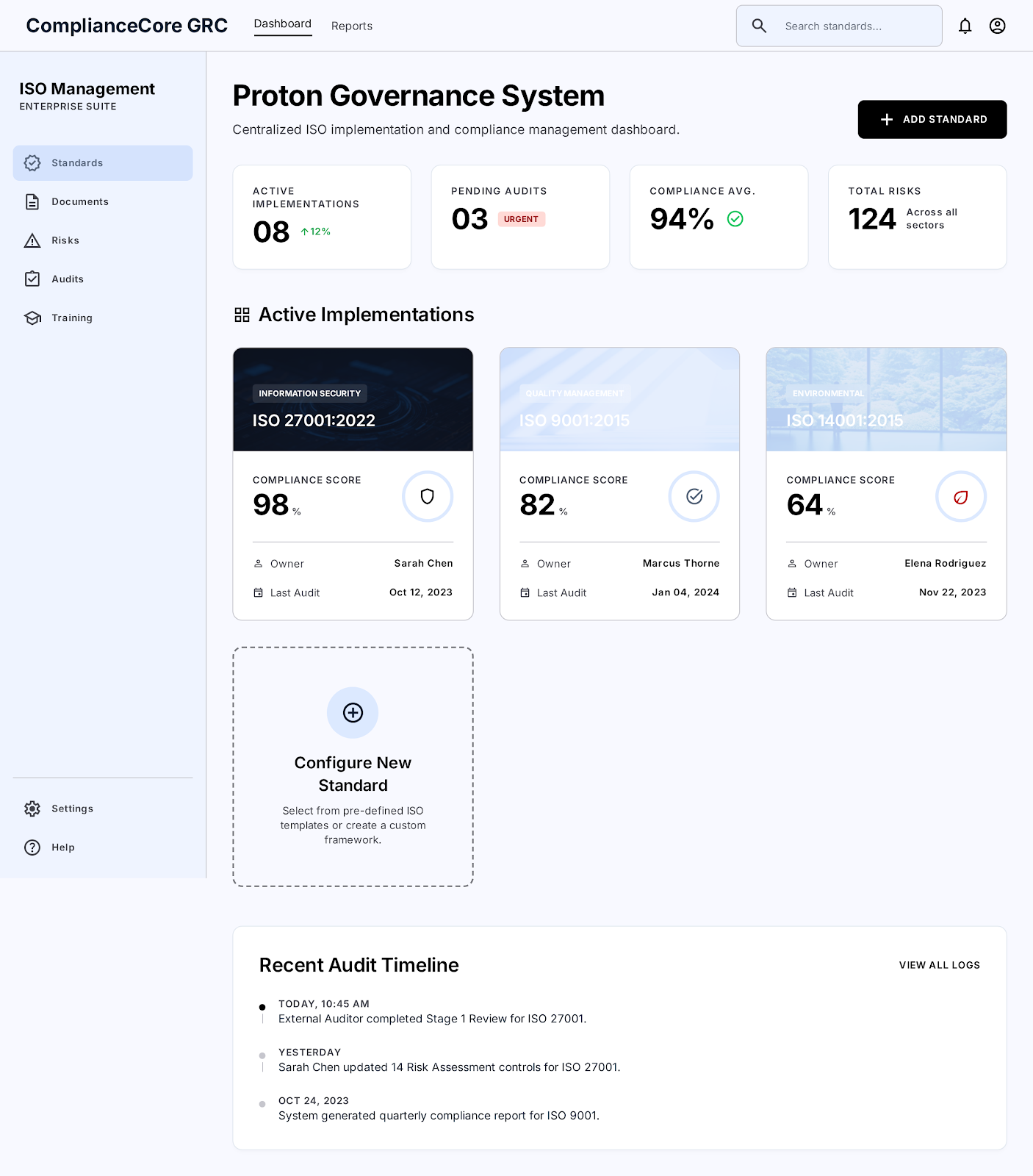
Because 4ES Hub supports 30+ standards through a unified Harmonized Structure, the same risk framework can serve ISO 9001 quality risks, ISO 14001 environmental aspects, ISO 45001 hazards, and broader enterprise risk programs. Risk settings include review periods and operation thresholds so teams know when reassessment is due and when scores exceed acceptable limits.
When an internal audit surfaces a finding, a nonconformity opens, or training gaps emerge, those records already share the same platform as your risk register. Management review can pull a coherent picture of risk posture, open treatments, and improvement actions—without exporting data from five tools.
Frequently asked questions
What is enterprise risk management (ERM) software?
ERM software is a digital platform that helps organizations identify, assess, monitor, treat, and report on risks across the enterprise. It replaces manual spreadsheets with centralized registers, structured workflows, scoring methodologies, control tracking, and audit trails—aligning with frameworks like ISO 31000 and management system standards such as ISO 9001, 14001, and 45001.
Does ISO 9001:2015 require risk management software?
ISO 9001:2015 does not mandate specific software. Clause 6.1 requires you to determine risks and opportunities and plan actions to address them. Software is not compulsory, but organizations that manage risks in spreadsheets often struggle to demonstrate consistent assessment, review, control effectiveness, and audit trails—exactly what auditors look for during surveillance visits.
What is RPN scoring in risk management?
RPN (Risk Priority Number) scoring typically multiplies factors such as severity, occurrence (likelihood), and detection into a single score that prioritizes which risks need treatment first. Pre-control RPN shows initial exposure; post-control RPN shows residual risk after operational controls are implemented—demonstrating that mitigation worked.
How does 4ES Hub handle risk assessments?
4ES Hub lets teams configure risk factors, scales, ranges, and matrices; define activities and organizational units; and run structured assessments with pre- and post-RPN evaluation. Each risk tracks causes, effects, status, and operational controls in the same platform as documents, audits, training, and nonconformities.
Can one risk system cover multiple ISO standards?
Yes. Because modern ISO standards share the Harmonized Structure (Annex SL), a unified platform like 4ES Hub can govern quality, environmental, safety, and information security risks through configurable matrices and shared review cycles—avoiding duplicate registers per standard.
See risk management inside 4ES Hub
If you want risk assessments, RPN scoring, operational controls, and review cycles connected to your full QMS—not isolated in a spreadsheet—we would love to show you how 4ES Hub fits your team.
Try free — start now