Why tracking audits in one platform matters for ISO-certified teams—and anyone working toward certification
Certification is a milestone. The audit trail is the job. When programs, evidence, and follow-up live in one connected system, surveillance visits feel less like a fire drill and more like showing the work you already do.
If your organization is ISO certified—or actively building toward it—you already know a quiet truth: the hardest part is rarely the audit itself. The hardest part is proving, months later, that you planned the right audits, executed them against the right criteria, captured findings with context, and closed the loop in a way an external auditor can follow without detective work.
Spreadsheets, shared drives, and long email threads can carry you through day-to-day operations. They tend to break under the pressure of a registrar question, a customer audit, or an internal review that asks for a coherent story across teams and time. What stakeholders want is not heroic recall from a single quality manager. They want a system of record.
The gap between “we did the work” and “we can prove it”
Many nonconformities are not failures of intent. They are failures of evidence: incomplete records, unclear ownership, missing linkage between a requirement and what was verified, or findings that never quite made it from conversation to documented corrective action. That gap is expensive. It creates rework, delays certifications, strains customer trust, and turns every surveillance audit into a scavenger hunt.
ISO management system standards are built on a simple idea: plan, do, check, act—and leave a trace. Internal audits are one of the primary ways organizations “check” whether controls are working as intended. If those checks are not structured, scheduled, and retained in a consistent way, you are asking your team to reconstruct reality under stress. That is the opposite of a mature management system.
What a strong audit program actually looks like
A credible audit program is more than a calendar reminder. It includes clear scope, defined criteria aligned to your standard and your risks, competent auditors, checklists that reflect how work is really done, and a disciplined path from observation to finding to corrective action. It also includes visibility: status, timelines, locations, and accountability that leadership can see without opening fifteen tools.
When audit activity is centralized, you reduce ambiguity. People stop debating which version of the checklist was used. You can show which audit instance ran, against which program and criteria, who participated, and what changed as a result. That is the kind of operational clarity ISO frameworks push organizations toward—not paperwork for its own sake, but repeatable discipline.
If you are already certified: fewer surprises, faster answers
Surveillance audits and customer audits do not reward heroics. They reward consistency. Teams that track audit programs, scheduled instances, and outcomes in a single platform typically spend less time assembling evidence packs and more time discussing real risks and improvements. Nonconformities become easier to prevent because patterns surface earlier: recurring findings, overdue follow-up, or gaps between procedure and practice.
There is also a cultural benefit. When audit history is visible and fair—not hidden in private inboxes—ownership improves. People learn that “closed” means documented, not “we talked about it in a meeting.” That shift alone can reduce audit anxiety across the organization.
If you are pursuing certification: practice like you are already certified
First-time certification is as much about habits as it is about documents. Registrars are not only looking for policies on a shelf. They are looking for evidence that the management system runs in the real world. A structured audit trail is one of the clearest signals that you are serious: you schedule audits, you execute them against defined criteria, you record findings, and you drive improvement from what you learn.
Starting early with a dedicated audit workflow helps you avoid the classic trap of bolting on “audit evidence” weeks before the stage two audit. You build muscle memory. Your teams learn where to log issues, how findings connect to corrective actions, and how management review can use audit results as input instead of anecdotes.
How 4ES Hub supports audit tracking end to end
4ES Hub is designed so audit work is not a parallel universe to the rest of your compliance system. Teams can define audit programs and criteria, maintain checklist definitions that match your processes, schedule audit instances with clear status from draft through completion, capture findings with the context auditors expect, and generate reporting that supports both operational review and external scrutiny.
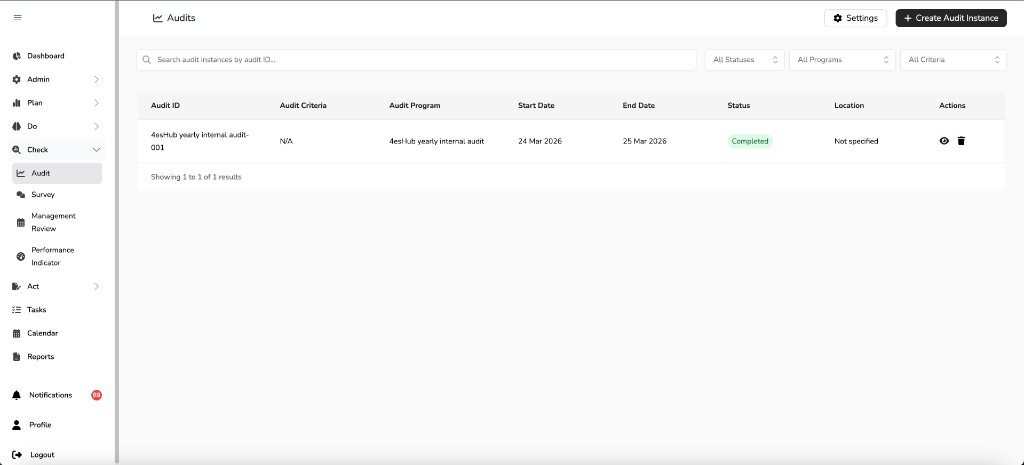
The point is not to add more steps. The point is to make the right steps the default: one place to see what is scheduled, what is in progress, what finished, and what still needs follow-up. When that visibility exists, ISO stops feeling like a separate project layered on top of the business—and starts feeling like how the business governs risk and quality every quarter.
ISO is a daily operating rhythm, not a one-time badge
Certification can feel like a finish line. In practice, it is a commitment to continuous evidence: internal audits, management review, corrective actions, and improvement cycles that repeat year after year. The organizations that make this look easy are rarely lucky. They are organized. They treat the audit trail as part of the product, not an afterthought.
If your next goal is a surveillance audit that is “boring” in the best way—predictable, well documented, and focused on substance rather than search—start by asking whether your audit history could survive a handoff. If a new quality lead joined tomorrow, could they reconstruct the last twelve months without calling half the company? If the answer is no, that is not a personal failure. It is a systems problem. And systems problems are exactly what modern compliance platforms are built to fix.
See audit management inside 4ES Hub
If you want audit programs, scheduling, findings, and reporting connected to the rest of your quality and compliance workflows, we would love to show you how 4ES Hub fits your team.
Try free — start now